


FAQs About Dysport Treatment
Dysport® is an injectable neuromodulator that temporarily reduces muscle activity responsible for certain facial expression lines. At Donnelley Dermatology in New York, NY, our team provides individualized evaluations to help patients understand the potential benefits, limitations, and safety considerations of Dysport treatment. Treatment recommendations are guided by facial anatomy, medical history, and personal aesthetic goals. For more information, contact us or schedule an appointment online. We are conveniently located at 1075 Park Ave, #1C, New York, NY, 10128.
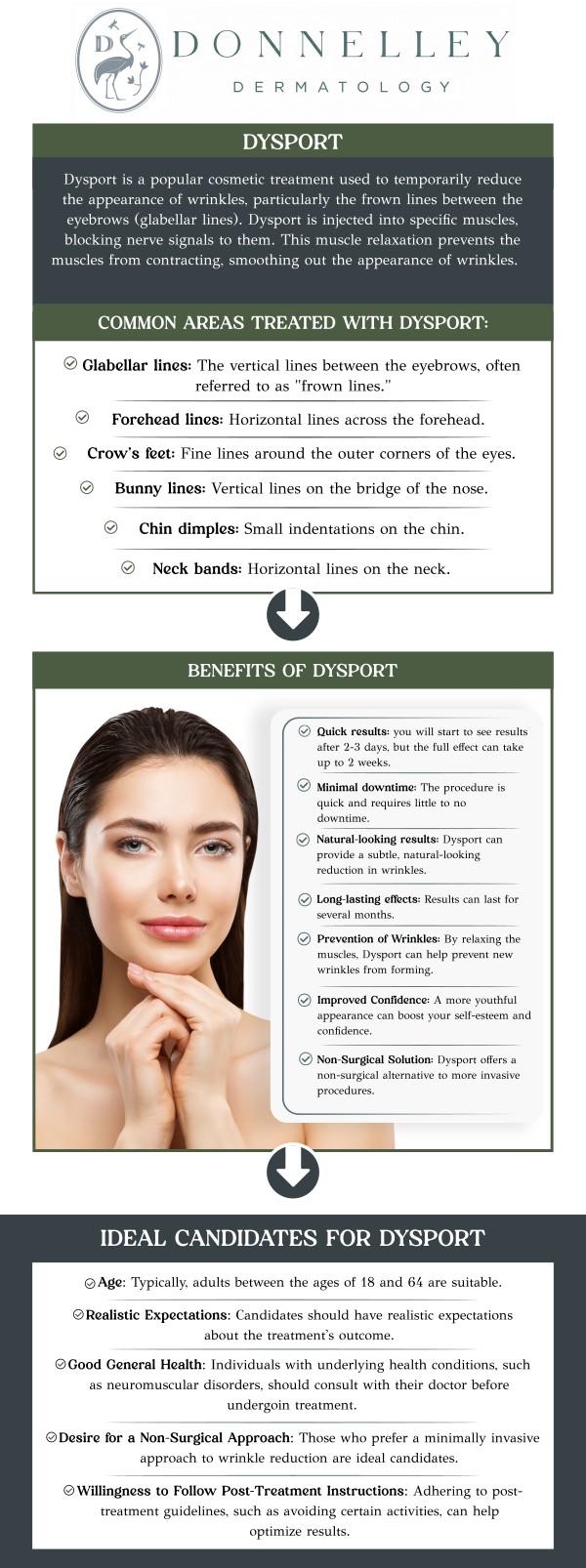
Table of Contents:
What is Dysport used for?
Am I a good candidate for Dysport?
What are the benefits of Dysport?
Is Dysport safe?
Are Dysport injections effective?
Where is Dysport injected?
What do I need to know before my Dysport procedure?
What do I need to know after my Dysport procedure?
Will I still be able to make facial expressions with Dysport?
Can Dysport reduce the appearance of aging?
What should I expect on the day of my Dysport treatment?
How does Dysport differ from Botox and Xeomin?
How quickly will I see results after Dysport treatment?
Does Dysport treatment hurt?
How does Dysport prevent future wrinkle formation?
Important Safety Information & Contraindications
Medical References
Dysport (abobotulinumtoxinA) is FDA-approved for temporarily improving moderate-to-severe frown lines between the eyebrows in adults younger than 65. It works by blocking the release of acetylcholine at targeted neuromuscular junctions, temporarily reducing muscle contractions that contribute to expression-related wrinkles. Qualified healthcare professionals may also use Dysport for forehead lines and crow’s feet as off-label treatments. Results depend on the treated muscles, injection technique, and individual response.
Adults seeking improvement in expression-related facial wrinkles may be candidates for Dysport following a medical evaluation. Suitability depends on facial muscle activity, medical history, allergies, previous botulinum toxin treatments, and cosmetic goals. At Donnelley Dermatology, our team considers these factors before recommending treatment. Dysport may not be appropriate for patients with certain allergies, active injection-site infections, or medical conditions that increase treatment-related risks.
Dysport temporarily reduces targeted facial muscle contractions, helping soften moderate-to-severe frown lines. Treatment is minimally invasive, generally requires a short appointment, and typically involves little interruption to daily activities. Results develop gradually and may provide a smoother appearance without surgery. The degree of improvement and duration vary among patients, and Dysport does not correct all types of wrinkles or restore facial volume.
Dysport has an established clinical safety profile for its FDA-approved indications when administered appropriately. However, potential adverse effects include bruising, headache, eyelid swelling, eyelid drooping, and unintended muscle weakness. Serious allergic reactions and distant spread of toxin effects are also possible. Patients with swallowing or breathing disorders or certain neuromuscular conditions may face increased risks. A pre-treatment assessment and informed consent are important components of safe care.
Clinical studies support Dysport’s effectiveness in temporarily improving moderate-to-severe glabellar lines. By reducing targeted muscle activity, injections can soften wrinkles associated with repeated facial expressions. The extent of improvement depends on muscle strength, wrinkle severity, dosage, and individual treatment response. Existing deep wrinkles may not disappear completely, and maintenance treatments may be considered as the effects gradually diminish.
For its FDA-approved cosmetic indication, Dysport is injected into specific muscles between the eyebrows, including the corrugator and procerus muscles. Qualified healthcare professionals may also administer Dysport in other facial areas, such as the forehead or around the eyes, for off-label cosmetic purposes. Injection locations depend on individual facial anatomy and treatment goals. Precise placement is important for limiting unintended weakness in surrounding muscles.
Before treatment, patients should disclose allergies, medical conditions, medications, supplements, and previous botulinum toxin injections. Certain medications may increase bruising risk or interact with Dysport. Patients should never discontinue prescribed blood thinners or other medications without approval from the healthcare professional managing their treatment. Any infection near the proposed injection site should also be reported. A consultation helps identify contraindications and establish appropriate expectations.
Most patients can resume routine activities shortly after Dysport injections. Temporary redness, tenderness, swelling, or bruising may develop around the injection sites. Patients should avoid unnecessary rubbing or pressure over recently treated areas and follow their dermatologist’s specific aftercare instructions. Strenuous activity may be temporarily restricted according to individual guidance. Persistent or unusual symptoms should be reported promptly.
Dysport temporarily weakens selected muscles rather than permanently eliminating facial movement. With appropriate treatment planning, many patients retain natural-looking facial expressions while experiencing improvement in targeted wrinkles. However, the degree of muscle relaxation varies, and unwanted weakness or asymmetry can occur. Facial anatomy, injection placement, and dosage influence the final appearance.
Dysport can improve certain visible signs of facial aging by temporarily softening wrinkles caused by muscle contractions. However, it does not directly correct collagen loss, pigmentation changes, or age-related facial volume reduction. Because facial aging involves several biological processes, results depend on the underlying cause of the patient’s concerns. Dysport provides temporary cosmetic improvement rather than permanent facial rejuvenation.
A Dysport appointment typically begins with an evaluation of facial muscle movement, treatment goals, and relevant medical history. The clinician then identifies appropriate injection sites and administers small amounts of the product using a fine needle. The injections generally take several minutes, although the overall appointment may take longer. Mild discomfort or temporary injection-site reactions can occur. Most patients leave shortly after the procedure.
Dysport, Botox, and Xeomin are injectable botulinum toxin type A products that temporarily reduce muscle activity. They differ in formulation, manufacturing characteristics, approved indications, and dosing requirements. Their potency units are not interchangeable. Clinical effects depend on the product, administered dose, injection technique, treatment location, and individual anatomy. No single formulation is universally superior for every patient.
Some patients begin noticing visible improvement within two to three days after Dysport injections. The full cosmetic response is commonly evaluated approximately two weeks after treatment, although timing varies. Effects often last around three to four months before muscle activity gradually returns. Treatment duration depends on individual response and other clinical factors. For FDA-approved glabellar treatment, repeat injections should not be administered more frequently than every three months.
Dysport injections typically cause brief discomfort described as a small pinch or stinging sensation. The procedure uses a fine needle, and the level of discomfort varies according to individual sensitivity and injection location. Temporary tenderness or minor bruising may occur afterward. Patients concerned about discomfort can discuss appropriate comfort measures with their healthcare professional before treatment.
Dysport temporarily reduces repetitive contractions in selected facial muscles, which may limit the repeated skin folding associated with expression-related wrinkles while the treatment remains active. However, evidence that routine Dysport injections reliably prevent permanent wrinkle formation over the long term is limited. Dysport does not stop skin aging, collagen changes, sun damage, or facial volume loss. Its effects are temporary, and future treatment decisions should be individualized.
Dysport is not appropriate for every patient. Before receiving injections, patients should undergo an appropriate medical evaluation to identify allergies, underlying health conditions, medication interactions, and other factors that could increase procedural risks.
Contraindications and Important Precautions:
• Allergic Reactions: Dysport should not be administered to patients with known hypersensitivity to botulinum toxin products, cow’s milk protein, or any formulation component.
• Injection-Site Infections: Active infection at the proposed injection site is a contraindication. Treatment should be postponed until the infection has resolved.
• Neuromuscular Disorders: Patients with myasthenia gravis, Lambert-Eaton syndrome, or amyotrophic lateral sclerosis (ALS) may experience increased sensitivity to botulinum toxin effects.
• Swallowing or Breathing Disorders: Pre-existing difficulties may increase the risk of serious treatment-related complications.
• Medication Interactions: Certain antibiotics that affect neuromuscular transmission, muscle relaxants, and anticholinergic medications may interact with Dysport.
• Pregnancy and Breastfeeding: Elective cosmetic treatment is generally deferred because adequate safety information is unavailable.
For more information, contact us or schedule an appointment online. We are conveniently located at 1075 Park Ave, #1C, New York, NY, 10128. We serve clients from New York NY, Bronx NY, Brooklyn NY, Manhattan NY, Harlem NY, and surrounding areas.
1. FDA – Dysport Prescribing Information
2. DailyMed – Dysport Official Drug Label
3. American Academy of Dermatology – Botulinum Toxin Treatment

Check Out Our 5 Star Reviews


ADDITIONAL SERVICES YOU MAY NEED
▸ Acne Treatment
▸ Birthmarks
▸ Eczema
▸ Warts
▸ Molluscum Contagiosum
▸ Viral Rashes
▸ Drug-Induced Rashes
▸ Rashes Treatment
▸ Seborrheic Dermatitis
▸ Fungal Infections
▸ Hives
▸ Dysport
▸ Fillers
▸ Fine Lines & Wrinkles
▸ Facial Volume
▸ Microneedling
▸ Fraxel Laser
▸ Intense Pulsed Light (IPL)
▸ Venous Stasis Dermatitis
▸ Pigmentation Treatment
▸ Melasma Treatment
▸ Dark Spots
▸ Freckles and Lentigines
▸ Cyst Excisions
▸ Mole Removal
▸ Skin Tags
▸ Skin Cancer Screening
▸ Basal Cell Carcinoma (BCC)
▸ Squamous Cell Carcinoma (SCC)
▸ Melanoma
▸ General Dermatology
▸ Psoriasis
▸ Rosacea
▸ Herpes Infections
▸ Shingles
▸ Hair Loss
▸ Dry Skin
▸ Seborrheic Keratoses

ADDITIONAL SERVICES YOU MAY NEED
▸ Acne Treatment
▸ Birthmarks
▸ Eczema
▸ Warts
▸ Molluscum Contagiosum
▸ Viral Rashes
▸ Drug-Induced Rashes
▸ Rashes Treatment
▸ Seborrheic Dermatitis
▸ Fungal Infections
▸ Hives
▸ Dysport
▸ Fillers
▸ Fine Lines & Wrinkles
▸ Facial Volume
▸ Microneedling
▸ Fraxel Laser
▸ Intense Pulsed Light (IPL)
▸ Pigmentation Treatment
▸ Melasma Treatment
▸ Dark Spots
▸ Freckles and Lentigines
▸ Cyst Excisions
▸ Mole Removal
▸ Skin Tags
▸ Skin Cancer Screening
▸ Basal Cell Carcinoma (BCC)
▸ Squamous Cell Carcinoma (SCC)
▸ Melanoma
▸ General Dermatology
▸ Psoriasis
▸ Rosacea
▸ Herpes Infections
▸ Shingles
▸ Hair Loss
▸ Dry Skin
▸ Seborrheic Keratoses
▸ Venous Stasis Dermatitis



 Send Text
 How May I Help You?